Mercedes Benz EQB EV Owner Gets Charger Installed After 2.5 Year Dispute With RWA


We all know that buying an electric vehicle in India is already very difficult due to them being more expensive. However, what makes owning them even more difficult is housing societies, which do not allow EV car owners to install chargers inside the premises. Recently, a Rs 1 crore Mercedes Benz EQB owner shared a tweet in which he announced the good news that finally, after 2.5 years of buying an EV, he can now finally charge his EV SUV at his home.
Rakshit Somani, who bought himself a brand-new Mercedes Benz EQB 2.5 years ago, shared this tweet on X. He highlighted that despite the government giving incentives such as zero registration fees, toll exemptions, and special EV electricity meters with nearly 50 percent lower tariffs, housing societies in India have now become a real obstacle in EV car owners' lives.
The EQB EV SUV owner mentioned that the cooperative housing society in which he stays refused to issue a “No Objection Certificate” (NOC) for more than 2.5 years. As per the society, the EV charger installation had “safety concerns,” even though the EV charger was approved by Mercedes Benz and the EV meter and wiring were sanctioned by the electricity board.

In his post, Somani has also mentioned that due to this dispute over non-issuance of NOC, he had to use commercial/public chargers. As per the EQB EV owner, the cost for charging at home comes to Rs 1.5 per km. Meanwhile, using public chargers, it rises to Rs 3.5 to Rs 4 per km. He highlighted that home charging directly offsets the inflation and makes EV ownership viable.
The above-mentioned incident is not the only one that has been shared online. Across major Indian cities such as Mumbai, Noida, Bengaluru, and Pune, people have reported similar issues regarding their housing societies. Most apartment dwellers face denial of permission for private chargers and are forced to use expensive society-installed community chargers. They also fine charging via domestic meters.

For any EV owner, charging at public infrastructure is inadequate, inconsistent, and often non-functional. Meanwhile, home charging provides overnight convenience and predictable costs and lastly reduces range anxiety. Hence, for apartment owners, allocated parking slots are the most logical for chargers.
The government of India and numerous states are working to help EV car owners in solving charging issues. Ministry of Power guidelines in September of 2024 stated that housing societies cannot stop residents from installing EV chargers in their designated parking slots. It highlighted that use of existing domestic meters is allowed, separate EV meters are optional, and load enhancement can be applied directly by residents. Lastly, RWAs cannot impose fines or force community chargers.
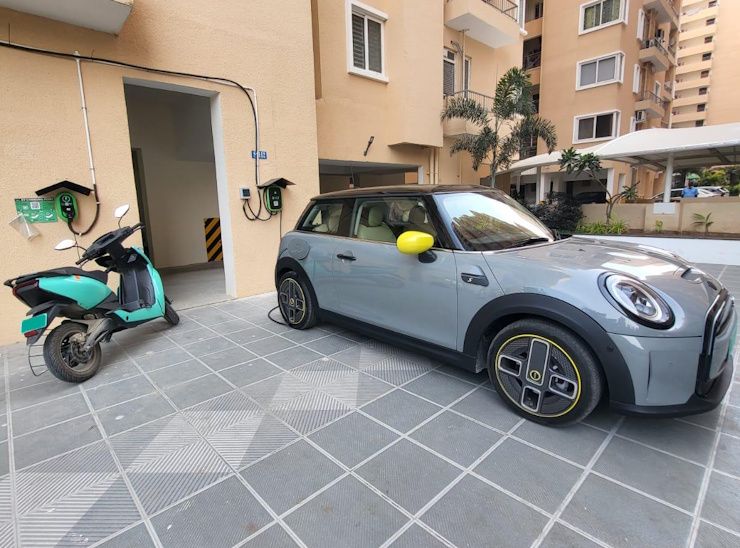
Now, even though the government is helping EV owners, it has to be mentioned that housing societies also have genuine compulsions as well. Most older societies were designed years before EVs existed. So, sanctioned electrical load often cannot support multiple EVs charging simultaneously and high peak demand at night.
As a result of this overloading, there is a risk of transformer failure, fire hazard, and penalties from discoms. EV charging involves high current draw, dedicated cabling, earthing, fire-resistant conduits, and ventilation. So, often retrofitting old societies with charging infrastructure becomes complex, expensive, and disruptive.
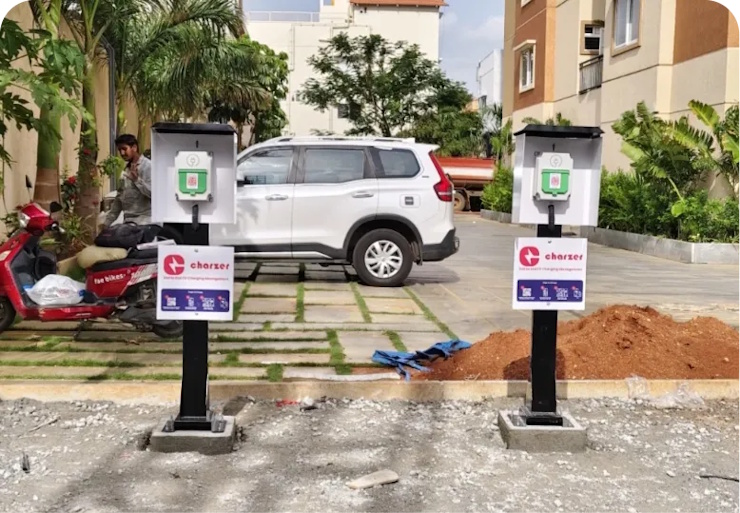
Societies not just in India but across the globe have become even more stringent after August 2024, when a Mercedes Benz EQE electric SUV exploded in a basement parking lot in Incheon, South Korea. It was reported that the car was parked for three days and was not charging. As a result of this explosion, over 140 cars burned down and 23 people were hospitalized. The entire society became unlivable, and electricity and water were disrupted for 5 days.
Hence, housing societies are sceptical when it comes to providing permissions for installation of chargers. They fear that if an EV fire takes place, they will be blamed for allowing installation, their insurance claims may be disputed, and fire NOCs can be revoked. Also, the National Building Code (NBC) has restricted EV charging in basement levels. However, most urban parking is underground, which makes it more difficult for societies to grant permission for charger installation.