Never Tow Your EV If It Runs Out Of Charge/Breaksdown: Here's Why!


Electric vehicles are gaining ground in India. Adoption has increased significantly in the past few years, and so has the number of EV models on sale. If you own an electric car or are considering one, here’s some golden advice: ‘Never wheel-tow your EV if it runs out of charge or develops a breakdown. Call a flatbed instead.’ Towing can damage your EV’s powertrain and core electrical components. Here are all the details.

We are used to handling breakdowns on ICE (Internal Combustion Engine) vehicles. Pushing the car or wheel-towing it are common practices. In most cases, we wouldn’t think of summoning a flatbed unless it is something dire.
In the case of electric cars, one should completely avoid pushing, wheel towing, or literally any practice that would make the wheels rotate. The reason is simple. It can damage the vehicle’s powertrain, as it isn’t designed to be moved mechanically without power. Before you ask, EVs do have ‘Neutral’ (N) mode. It, however, works differently here. It is software-controlled and not mechanical.
The electric powertrains of most EVs are quite complex. They come with an advanced regenerative braking technology that captures kinetic energy during deceleration, turns it into electrical energy using a complex setup, and sends it back to recharge the EV battery. This, in the larger picture, increases the overall range and reduces brake wear. These days, EV models offer selectable regen levels, the highest of which can be very powerful.
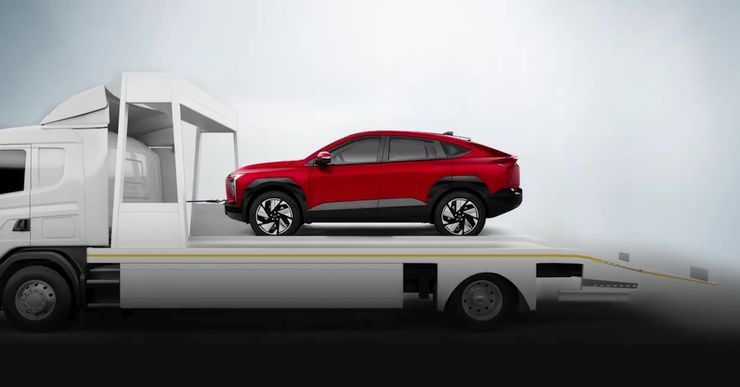
If you start pushing or wheel-towing a vehicle in the event of a breakdown, the wheels get into motion, thereby spinning the motor and triggering the regenerative braking system. This will send unintended current into the system and may eventually damage the EV’s power electronics (the electronic brain that manages all electricity flow within the system.)
The motor and inverter will also be damaged if we push or wheel-tow the vehicle for long distances. It can also create overheating issues and trigger associated hazards. In any of these cases, repairs and replacements will be expensive.

Brands like Tata, Mahindra, and MG make electric vehicles that are best-suited for India’s road and climatic conditions. The user manuals of these companies clearly state the risks associated with pushing or towing their EVs in the event of a breakdown, and mentions that the vehicle’s warranty will not cover damages caused by these.
We understand that waiting for a flatbed will not be ideal in all cases. In some scenarios, you will need to push the car a couple of meters, maybe to get it to the side of the road or to unclog an area. In such cases, you have to make sure that the ‘pushing’ is done in a way that would minimise damage to components. Continuous pushing may not be possible on many EVs. Implement a ‘Push- Release- Push’ strategy instead.
Two things need to be closely monitored- vehicle speed and distance. While moving the vehicle, its speed should always be less than 5kph. Do not move it for more than 10 feet in this manner.
Reach out to the RSA (Road Side Assistance) as soon as possible, for moving the electric car to the nearest service station and getting the issue resolved. Also, make sure that the vehicle is transported on a full-size flatbed truck and not on a wheel-lift truck.