Tata Harrier Petrol's ADAS Did Not Stop For Scaffold On Road: We Explain Why [Video]


A lot of modern cars, including the soon-to-be launched Tata Harrier petrol, come equipped with Auto Emergency Braking (AEB). This safety feature applies brakes in case the driver is not paying attention on the road. Now, in a lot of cases, this has helped in avoiding major accidents. However, there are some situations where it might not work as effectively. Recently, a video showing how a Tata Harrier petrol did not apply AEB for a scaffold on the road has been shared online.
This video showing how the Tata Harrier petrol failed to stop for a wooden stickman has been shared on Instagram by M Ravi Thakur on their page. It starts off with the influencer showing a makeshift stickman on the road wearing a T-shirt and a pair of jeans. He then states that viewers might get confused as to what it is. However, he then explains that it has been made by them to perform a test.
Soon after this, he then shows the new Tata Harrier petrol and mentions that this SUV comes equipped with the safety feature – Auto Emergency Braking (AEB). Following this, he explains that with the help of this feature, the vehicle detects a person or an obstacle on the road and applies brakes on time to avoid a collision, and this is what they will be testing with their makeshift dummy.

What happens next is that the influencer takes the driving seat and starts driving towards the scaffolding. He states that he will not apply the brakes and will let AEB work. It can then be seen that the Harrier petrol fails to apply the brakes on time and hits the stickman, following which the influencer steps out and mentions that the brakes were applied after the vehicle hit the stickman.
He then concludes that these systems are good but not completely accurate, and people should pay complete attention on the road. The influencer added that these features cannot be fully relied on, and human intervention becomes necessary.
Automatic Emergency Braking is part of the ADAS Level 2 suite of the Tata Harrier petrol and other Tata SUVs which come with it. Now, the first reason why AEB did not work is that it has not been designed to work at 70 kmph. Tata’s ADAS, just like other automakers’ ADAS, has been designed to not automatically brake for stationary objects at high speeds.
At such speeds, the ADAS issues a Forward Collision Warning (FCW) to bring drivers’ attention on the road. It does not automatically apply brakes at high speeds. Typically, AEB will work at speeds in the range of 40–60 kmph and below. Additionally, the scaffolding or makeshift stickman seen in the video is not a legitimate obstacle as per the ADAS system.
The Level 2 ADAS of Tata Motors cars and other automakers is trained to detect and classify specific objects such as vehicles, pedestrians, and cyclists. Hence, it was not detected. For those who may not be aware, cameras and radar work in harmony in ADAS to ensure safety.

Advanced Driver Assistance Systems rely on a two-step confirmation process. The first is radar detection, and the second is camera verification. In this particular case, the radar likely detected the stationary object. However, such objects are often filtered out to avoid false positives. In most ADAS systems, when the radar flags something irregular, the camera must confirm multiple conditions before AEB can activate.
For AEB to get activated, the camera must clearly confirm which object is in front. It must also be confirmed that the object is in the lane. Also, there should be adequate time to collision, and lastly, there should be sufficient contrast and visibility. In this case, the scaffold failed to meet the above criteria; hence, the camera confidence remained below the braking threshold.
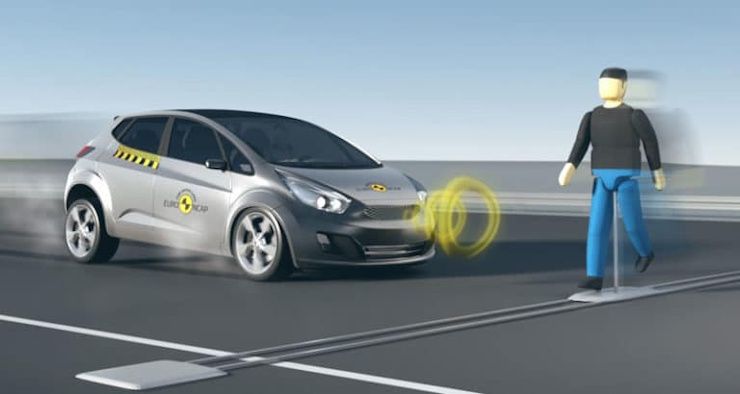
Now, for those wondering why the ADAS AEB does not work for all objects, the answer is that if it starts braking for cardboard boxes, plastic barricades, cones, and temporary scaffoldings, it could easily cause rear-end collisions, loss of vehicle control, and multi-car pile-ups on highways. Hence, manufacturers deliberately tune ADAS to avoid unnecessary emergency braking.