Honda Plots EV Plan To Regain Marketshare In India


Honda Cars sold 10,036 units in March 2026, down 18 percent from 12,246 units in the same month last year. That number is a domestic + export wholesale figure, meaning vehicles dispatched from factory to dealerships, and cars exported. Domestic sales stood at 7,585 units while exports amounted to 2,451 units. The drop is significant because March is typically the strongest month of the financial year, when dealers push hard to clear inventory before the books close. Falling in March points to softer-than-usual demand pull from the market.
The full FY26 picture is not better. Honda's monthly numbers have been declining through the year. In January 2026, total sales stood at 6,941 units, down from 12,304 in January 2025 when strong exports padded the total. February 2026 saw just 7,212 units against 10,323 in February 2025, a 30 percent drop. The critical detail buried in those numbers is that domestic sales have remained broadly flat: Honda's February 2026 domestic retail of 5,629 units was almost identical to 5,616 units in February 2025. The headline decline is being driven almost entirely by a collapse in exports, which fell 66 percent year-on-year in February and 85 percent in January. That is a different kind of problem from weak domestic demand, but it still weighs on overall volumes and profitability.

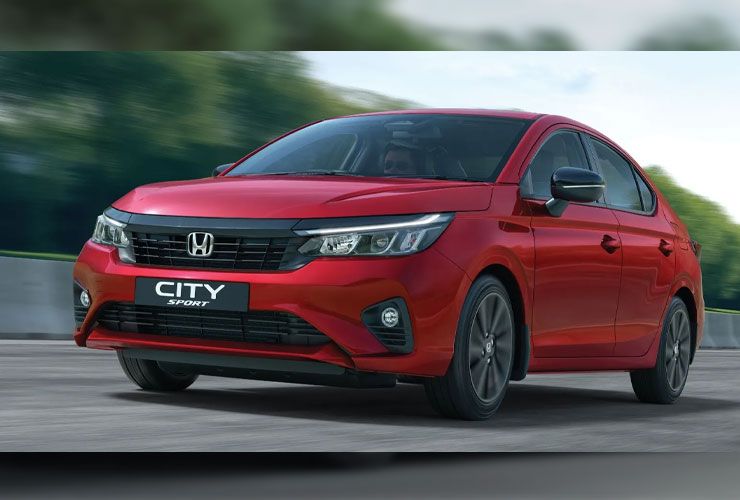
The model-level data tells the story plainly. In January 2026, the Amaze accounted for 3,449 units, the Elevate for 2,243 units, and the City for just 501 units. The City, once Honda's core volume driver, now sells fewer than 600 units a month in most months. That is a steep fall for a car that once consistently crossed 4,000 to 5,000 units monthly. The Elevate, which was expected to compensate, sold 23,551 units across the 12 months ending February 2026, averaging under 2,000 units a month.
The core problem is product age relative to competition. The City competes against the Maruti Suzuki Ciaz, Hyundai Verna, and increasingly against sub-Rs 15 lakh SUVs that buyers consider roomier and more practical. The Elevate is Honda's only SUV in a market that has moved decisively toward utility vehicles. Rivals like Maruti, Hyundai, Tata, and Mahindra each have three to six SUV nameplates in active production. Honda has one. Exports have partially cushioned the overall picture, shipping from its Tapukara and Vithalapur plants to Middle East and other markets, but that pipeline has shrunk considerably this year.

Honda has confirmed an all-new electric SUV launch for the market in the first half of 2026, not a derivative of the Elevate but a ground-up electric model. It will be the first global market to receive this BEV, ahead of other markets. The expected battery pack is in the 45 to 60 kWh range, with a claimed range of around 500 km. A front-wheel-drive single-motor setup producing approximately 140 bhp and 200 to 250 Nm is expected. Fast charging from 20 to 80 percent is targeted at around 35 to 40 minutes on a 100 kW DC charger. Expected pricing ranges from Rs 14 to 18 lakh, which would put it directly against the Hyundai Creta Electric, Tata Curvv EV, and Maruti e Vitara.
Honda is also planning an Elevate Hybrid for the second half of 2026, using the same 1.5-litre Atkinson cycle petrol plus dual-motor hybrid system that powers the City e:HEV, which currently claims 27.13 kmpl. Beyond these two, Honda has outlined a plan to launch 10 new models by 2030, of which seven will be SUVs. The Honda 0 Alpha, a fully electric global SUV, is confirmed for 2027, with production based locally for export as well. The product pipeline, in other words, is real. The question is whether the launches come fast enough to arrest a share slide that has been running for several months.