New CAFE 3 Draft Has Quietly Shifted the Rules: Here's What Changes, And Who Benefits.


The government's latest draft for CAFE 3, the third phase of India's Corporate Average Fuel Efficiency norms that kicks in from April 1, 2027, has significantly softened the emission targets compared to what was originally proposed in September 2025. The Bureau of Energy Efficiency has circulated a revised draft among carmakers where the fleet-wide CO2 targets have been relaxed by about 21 percent versus that first proposal. The auto industry and the concerned ministries are scheduled to meet shortly to finalise the norms.

CAFE norms work by setting a fleet-average CO2 emission limit for every manufacturer. You do not have to meet the limit on every individual car you sell; you have to meet it across the average of all the cars you sell in a year. The target is set along a curve based on vehicle weight, with heavier vehicles allowed slightly higher emissions per kilometre.
The most significant technical change in the latest draft is a flatter emission curve. In the September 2025 proposal, the slope factor used to calculate each manufacturer's specific target was set at 0.002 across all five years of CAFE 3 (FY28 to FY32). The new draft reduces that slope to 0.00158 in year one and brings it down gradually to 0.00131 by year five. A flatter slope means the gap between what heavy vehicles and light vehicles are allowed to emit narrows over time. Heavy vehicles like SUVs face tighter targets, while lighter vehicles below the industry average weight of 1,229 kg get more breathing room.
The numerical changes are bigger than they first look. The reference vehicle weight in the formula has been raised from 1,170 kg to 1,229 kg, an increase of 59 kg, or just over 5 percent. The baseline consumption constant for FY28 has also been increased from 3.7264 litres per 100 km to 3.9960 litres per 100 km, which is a rise of a little over 7 percent. Those two shifts, combined with the flatter slope, explain why the new draft is materially easier to comply with than the September version. In simple terms, the revised curve moves upward and becomes less steep, which reduces the compliance pressure on the industry as a whole while still tightening the framework over the five-year period.
The earlier drafts included an explicit 3 gram per litre CO2 relief specifically for small cars weighing up to 909 kg. That carve-out has been dropped entirely in the latest version. The trade-off is that the flatter curve gives small car manufacturers a larger effective benefit than that 3g/litre concession ever would have. One industry executive quoted in coverage of the draft said the new slope provides small car makers "much more than 3g per litre" in effective relief. Another comparison helps show the shift: an entry-level car that would earlier have needed about a 47 percent emission reduction by year five is now looking at a reduction closer to 36 percent. That is still demanding, but it is a meaningful easing from the earlier draft.
The baseline consumption constant, a technical input in the target calculation formula, has also been raised from 3.7264 litres per 100 km to 3.9960 litres per 100 km for FY28. That upward revision loosens the overall targets across the board for the first year of implementation.

Super credits, which allow a manufacturer to count each clean vehicle sale as more than one vehicle in their fleet average calculation, have been revised. Battery electric vehicles get the maximum super credit of 3, meaning each BEV sold counts as three cars in the fleet average. Strong hybrids have been cut from 2 to 1.6. Range-extender EVs remain at 3. The message is unambiguous: the government wants BEV adoption, and the incentive structure now clearly favours it over hybrids.
An OEM that cannot meet its annual fleet target can buy credits from other manufacturers through a pooling mechanism, or directly from the BEE. The credit price starts at Rs 2,500 per gram of CO2 per km in FY28 and rises by Rs 500 per year to Rs 4,500 per gram in FY32. That means the credit cost rises by 80 percent over the five-year period, giving manufacturers a strong reason to either improve fleet efficiency early or secure cleaner-vehicle volumes rather than rely on last-minute credit purchases. Penalties also apply if targets are missed without credits.
Maruti Suzuki sells more small, lightweight cars than any other manufacturer in the country. Under the old draft, the explicit small car exemption gave Maruti a direct numerical advantage. Under the new draft, that advantage is larger but embedded in the curve rather than called out by name, which resolves the debate that had divided the industry.
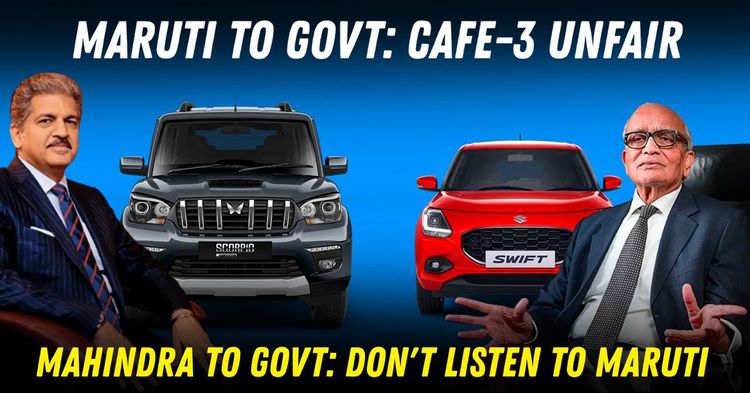
Tata Motors, Mahindra, Toyota Kirloskar, and JSW MG Motor India had all opposed any special treatment for small cars, arguing for a single uniform standard. The latest draft does not name small cars separately, so the objection to preferential treatment technically falls away, even though the outcome for small car-heavy portfolios is more favorable than before.
Another important detail is scope. These norms apply to M1 passenger vehicles, which covers cars designed to seat up to nine people and with a gross vehicle weight of up to 3,500 kg. So while the headline debate has centred on hatchbacks and SUVs, the rulebook is really about the entire passenger vehicle fleet mix that manufacturers sell. The April 1, 2027 implementation date has not changed, but manufacturers have flagged that unless the final notification is issued in the coming days, the timeline will be extremely hard to comply with.