Kia Syros EV Just 2 Months Away From Launch: What To Expect


Kia has confirmed in its 2026 investor presentation that the Syros EV will debut in July 2026. It will be Kia’s second locally manufactured electric vehicle after the Carens EV, and the fourth EV in Kia’s total line-up for this market.

The Syros EV is expected to share its underpinnings with the Carens EV, which means the battery and powertrain are likely to be closely related. The expected configuration is a 42 kWh battery pack with an electric motor producing 133 bhp and 255 Nm of torque.
At 133 bhp, the Syros EV will have more power than the Tata Nexon EV’s 127 bhp and match the Mahindra XUV 3XO EV’s 130 bhp. No official range figure has been confirmed, but on the same battery pack and similar weight, a 340 to 380 km real-world range is a reasonable expectation.
Those expected numbers place the Syros EV in a fairly competitive position on paper. A 42 kWh battery is large enough to keep it above the entry-level EV bracket, while 255 Nm of torque should deliver the kind of instant response buyers now expect from an urban electric SUV.
The likely real-world range estimate of 340 to 380 km is important because that translates into a practical weekly-use pattern for many private owners. Even at the lower end of that band, a user driving 35 to 40 km a day could go close to a week between charges. In other words, Kia does not need class-leading range to make the Syros EV attractive. It needs enough usable range, good charging speed, and the right price.
There is another number that matters here. If Kia keeps the Syros EV close in weight and format to the ICE car, then a 133 bhp output in a sub-compact SUV body should be enough to make performance feel brisk rather than merely adequate. That would help differentiate it from lower-output commuter EVs and position it as a more rounded family product rather than just a city-only alternative.
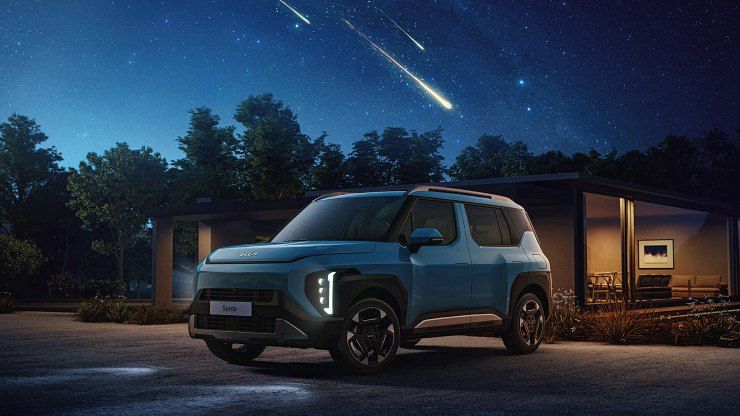
The Syros has been on sale since January 2025 with petrol and diesel options. It enters the sub-compact SUV space, which is the segment that includes the Nexon, Brezza, Venue, and Sonet, starting at Rs 8.99 lakh ex-showroom.
Its USP on the ICE version has been a remarkably spacious rear cabin and an unusually generous features list relative to its price point. The panoramic sunroof, rear AC vents, a large 10.25-inch infotainment screen, and rear-seat recline features have been frequently highlighted by owners as strengths.
Kia has confirmed the Syros EV will look almost identical to the standard Syros externally, with differences limited to the grille treatment and likely the wheels. That is the same approach taken by the Nexon EV relative to the petrol Nexon, and it keeps development costs and parts sharing manageable.
That matters because it allows Kia to enter the EV space faster and with fewer compromises on packaging and cost. Carrying over most of the body and cabin from the ICE model also means buyers are likely to get the same strong rear-seat usability that already defines the Syros. In this part of the market, rear-seat comfort and feature count can influence buying decisions almost as much as battery size. If Kia preserves the same cabin strengths in the EV, the product will not be relying on the electric powertrain alone to attract buyers.
The expected carryover approach also helps with manufacturing efficiency. Shared parts, shared body panels, and limited cosmetic differentiation usually help companies manage costs more tightly. That becomes important in a segment where even a pricing difference of Rs 50,000 to Rs 1 lakh can change the buyer’s shortlist.

The sub-compact electric SUV segment is set to be the busiest battleground of 2026 and early 2027. The Nexon EV is the established volume leader, selling around 4,000 to 5,000 units a month. The XUV 3XO EV is the Mahindra entry into this bracket. The Syros EV adds a third credible product to a segment that, until recently, had limited genuine competition for the Nexon. Expected pricing is in the Rs 14 to 20 lakh range, which would place it broadly in line with the Nexon EV’s mid and top variants.
That Rs 14 to 20 lakh band is broad, but it gives a useful clue about Kia’s strategy. At the lower end, the Syros EV would sit within reach of buyers stepping up from well-equipped petrol compact SUVs. At the upper end, it would overlap directly with larger-battery and better-equipped variants from rivals. This means the final pricing structure will matter more than the headline starting price. A sharp entry price can draw attention, but the real volume usually comes from the middle variants. If Kia prices those well, the Syros EV could become more than just a brand-expansion product.
The ICE Syros has not been a volume runaway success yet. Its sub-compact segment rivals, especially the Brezza and Venue, have been consistently outselling it on a monthly basis. The EV variant gives Kia an opportunity to reset the Syros’s commercial narrative in a segment where buyer attention and interest are high. Whether the 42 kWh pack and the 133 bhp output are enough to displace Nexon EV loyalists will depend significantly on pricing and charging speed, two details Kia has not yet announced.
It will also depend on how convincingly Kia positions the Syros EV as a family-friendly electric SUV rather than simply an electric version of an existing product. The hardware expectations are already reasonably clear. The unanswered questions are now about price, charging, and value. Those three factors will decide whether the Syros EV becomes a serious segment player or just another addition to an increasingly crowded EV list.