1 In 5 Mahindra SUVs Sold Is Either A Thar Or Thar Roxx


Mahindra sold 6,60,276 SUVs in FY2026. Of those, 1,26,261 were either a Thar or a Thar Roxx. That works out to 19.1 percent of Mahindra’s total domestic SUV sales, up from 15 percent the year before. In practical terms, one in every five Mahindra SUVs sold is now a Thar-family vehicle.

That is a significant jump in mix in just one year. A move from 15 percent to 19 percent may sound modest at first, but it is a rise of 4 percentage points, or roughly 26.7 percent in share terms. For a brand already operating at high volumes, that is a major shift.
It also means the Thar family is now contributing an average of about 10,522 units a month across the full financial year. That level of sustained monthly demand is what pushed it past the XUV 3XO and made it Mahindra’s second-best-selling nameplate.

The growth is almost entirely down to the Thar Roxx. The five-door version, launched in August 2024, has progressively taken over internal share from the original three-door. In the April to June 2025 period, the Thar Roxx accounted for 68 percent of total Thar brand sales with 20,726 units against the three-door’s 9,908 units.
That means total Thar-family sales in that quarter stood at 30,634 units, with the Roxx outselling the three-door by 10,818 units in just three months. On a monthly basis, that quarter alone worked out to about 6,909 Roxx units and 3,303 three-door units.
In March 2026, combined Thar family sales were 10,872 units. Monthly volumes now regularly sit between 10,000 and 13,000 units, a number the three-door Thar could never achieve on its own. Even March’s figure, if annualised, points to a run rate of over 1.30 lakh units a year.

The Thar’s commercial success starts with one simple thing: it looks like no other car at this price point. The boxy, upright silhouette with round headlamps is a shape people recognise from the original Mahindra Jeep, which has been on roads since the 1940s. It is a silhouette that reads as tough and characterful. No amount of market research can manufacture that kind of instant visual identity. In a segment full of sleek, rounded SUVs that look increasingly similar, the Thar stands out immediately in traffic.
That distinct design matters because it gives Mahindra something most mass-market SUVs do not have: instant recognisability across variants and price points. Whether it is a base three-door or a top-end Roxx, the buyer gets the same broad visual appeal. That helps the nameplate carry premium pricing better than a conventional compact or midsize SUV would. It also means Mahindra did not have to reinvent the Thar formula to grow it. The company simply widened the use case.

The three-door Thar was always aspirational but limited in practical utility. The rear seat was cramped, access was awkward, and the boot was barely adequate. It worked for buyers who wanted a lifestyle vehicle and used it that way. The Roxx removed all three objections by adding two proper rear doors, genuinely comfortable seating for four adults, a usable boot, and rear AC vents.
The wheelbase went from 2,450 mm to 2,850 mm. That 400 mm increase is not a cosmetic change. It fundamentally alters cabin packaging, rear-seat legroom, and load-carrying usability. The result was a car that kept the Thar’s off-road credentials and visual identity while becoming a real everyday vehicle.
The Roxx also added a petrol option starting at Rs 12.39 lakh in the MX1 base form, which opened the nameplate to a new group of buyers who had ruled out diesel on cost or driving preference grounds. The 2.0-litre turbo-petrol in the Roxx makes 162 bhp with the manual and 177 bhp with the automatic.
That is significantly stronger than the 1.5-litre diesel 117 bhp three-door Thar, which is positioned as the entry off-road option at under Rs 10 lakh. The numbers show how much broader the Roxx brief is. A buyer can now enter the Thar line-up at below Rs 10 lakh with the three-door, step into a more family-friendly Roxx from Rs 12.39 lakh, and go all the way up to around Rs 22 lakh for a top-spec 4WD diesel automatic.
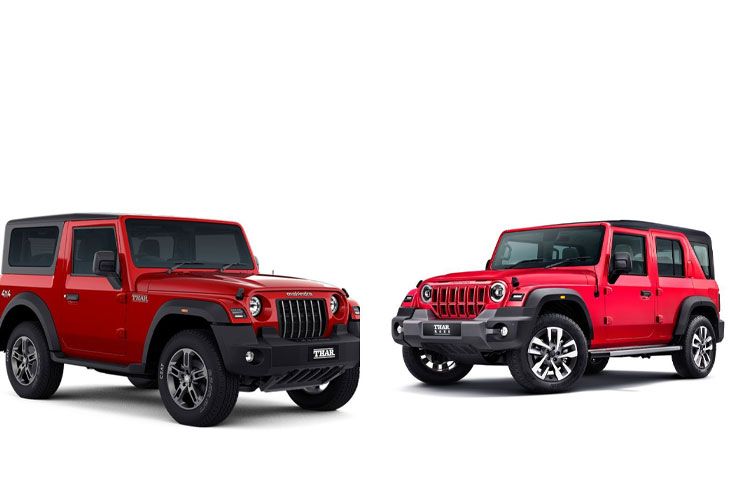
The Thar family now covers a remarkably wide brief. At Rs 9.99 lakh, the three-door gives you a ladder-frame diesel SUV with a body style that has cult following. The Roxx in RWD petrol starts at Rs 12.39 lakh, goes up to about Rs 22 lakh for the fully loaded 4WD diesel automatic AX7L.
That is a spread of roughly Rs 12 lakh from entry to top end, which is unusually wide for a single SUV family. In between, there are 21 variants covering manual and automatic, petrol and diesel, and RWD and 4WD configurations. That breadth matters because it allows Mahindra to stretch the same brand across very different buyer budgets and use cases.
The 4WD versions come with three differential locks, front, centre, and rear, 4Hi and 4Lo transfer case modes, and ground clearance of 226 mm. That is genuine off-road hardware, not marketing. Yet the family also now includes more urban-friendly versions that buyers will never take off-road.
That dual character is central to the sales story. One part of the range sells on authenticity. Another sells on image and road presence. Between those two, Mahindra has built a product line that can do lifestyle duty, family duty, and enthusiast duty without needing three separate nameplates.
The Star Edition added a cosmetic variant with an all-black interior and exterior treatment, priced from Rs 16.85 lakh, which expanded the range further without requiring a mechanical update. That helps keep the line-up fresh while preserving margins.
What the 19 percent share confirms is that the Thar formula translates at real volumes. It is not a niche product anymore. At 1,26,261 units in FY2026, the Thar family is operating at a scale that makes it one of Mahindra’s most important growth engines, not just one of its most recognisable SUVs.