Maruti Dzire Beats SUVs To Become India’s Best Selling Car For A Full Year


Maruti Suzuki’s Dzire ended FY26 as the highest-selling car in the country. It recorded around 2.3 lakh wholesale dispatches between April 2025 and March 2026. In a market where utility vehicles now make up roughly 66 percent of all passenger vehicle sales, a compact sedan securing the overall top position is an unexpected outcome. The Dzire consistently outperformed high-volume SUVs like the Tata Nexon, Tata Punch, Hyundai Creta, and Maruti’s own Brezza over the 12-month period.

Dzire maintained a monthly average of just over 19,000 units which helped it top the charts. It stayed in the top three best-selling cars almost every month, regularly trading the number one spot with Tata’s compact SUVs.
The sedan market has been losing ground to SUVs for several years. Multiple carmakers have either reduced their sedan line-ups or exited the body style completely. Maruti Suzuki discontinued the mid-size Ciaz last year, leaving the Dzire as the sole sedan in its entire portfolio.

Despite the broader segment shrinking, Maruti’s share of sedan sales has grown from 45.8 percent in FY2017 to 57.2 percent in FY26. This market share is driven entirely by the Dzire. Looking at the February 2026 sales data, the Dzire registered 19,326 units.
This single model captured a 54 percent share of the entire sedan segment for that month. Competing models, including the Hyundai Aura, Honda Amaze, Tata Tigor, Skoda Slavia, and Volkswagen Virtus, had to split the remaining 46 percent of the volume.
The continued demand for the Dzire is tied to its pricing and running costs. The car is priced from Rs 6.26 lakh to Rs 9.31 lakh, ex-showroom. This undercuts most entry-level and compact SUVs by a significant margin, making it a default choice for budget-conscious buyers.

It is powered by a naturally aspirated 1.2-litre petrol engine, available with either a manual gearbox or an automated manual transmission. The engine delivers a claimed fuel efficiency figure above 22 kmpl.
Maruti also offers a factory-fitted CNG variant, which further reduces running costs. This efficiency appeals heavily to fleet operators who track daily expenses closely, as well as private buyers looking for an economical commuter.
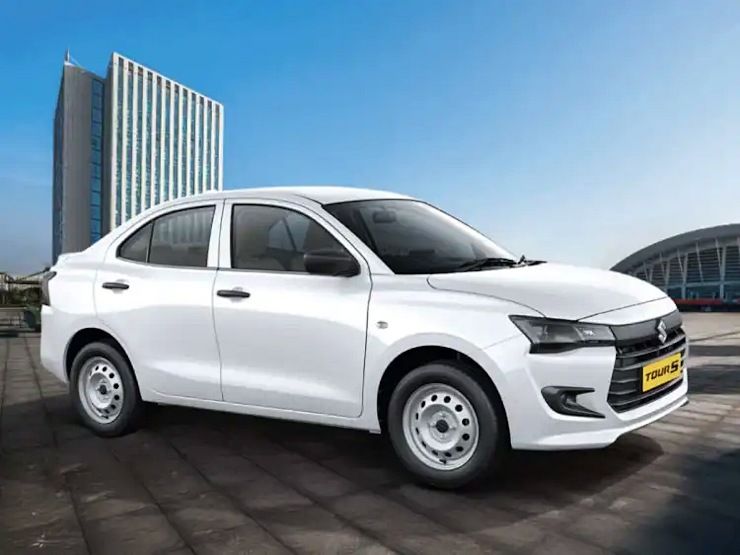
Maruti Suzuki has stated that demand for the Dzire is split fairly evenly between fleet buyers and private owners. The vehicle serves as a commercial taxi in its Tour S guise and as a personal family car, sustaining high factory output without requiring distinct body styles.

Monthly sales are heavily skewed toward SUVs. In February 2026, the Tata Nexon led the market with 19,430 units, with the Dzire close behind at 19,326 units.
The Tata Punch and Hyundai Creta followed them. However, when these monthly fluctuations were averaged out over the full financial year, the Dzire maintained a steadier run rate, allowing it to overtake the SUVs in total cumulative volume.
This performance contributed heavily to Maruti Suzuki ending FY26 with record total wholesales of 2.42 million units. The Dzire relies on a very simple mechanical formula in a market that is increasingly shifting toward turbochargers, hybrid systems, and electric powertrains. The lower purchase price, high fuel efficiency, and access to Maruti's extensive service network have kept the volumes intact, allowing a traditional compact sedan to outsell every SUV on the market.