Maruti Suzuki eVitara Electric SUV Sales Stand At 870 Units In February 2026


Maruti Suzuki’s first electric SUV has opened its account with two very different numbers, and both matter. In February, the company dispatched 870 eVitara units to dealers, but retail registrations stood at 222 units. On paper, the dispatch figure looks healthy for a brand-new EV. The retail number, however, shows that the real market test has only just begun.

That gap is not necessarily a warning sign yet. Deliveries for the eVitara started only on February 17th, so it had barely half a month to turn showroom stock into actual customer handovers.
Even so, the contrast is worth watching because it tells you where the model stands right now. Maruti has pushed meaningful inventory into the network, but customer offtake is still at the early build-up stage.
The eVitara made up just 1 percent of Maruti Suzuki’s 72,756 utility vehicle dispatches in February. Within the company’s own UV range, it ranked seventh out of nine models by wholesale volume. On the retail side, its 222 units gave it a 1.52 percent share of the 14,553 electric cars, SUVs and MPVs registered during the month.
The dispatch number looks even more modest when placed against the month’s best-selling EVs. February’s top-selling electric model was Mahindra’s XEV 9S with 3,539 units, followed by the MG Windsor at 2,599 and Tata Nexon EV at 2,410. Mahindra’s XEV 9e was at 1,889, Tata Harrier EV at 1,738, Tata Curvv EV at 1,250, Tata Tiago EV at 1,226, Mahindra BE 6 at 1,104 and Tata Punch EV at 1,061.

The eVitara, at 870 units, was tenth. That means Maruti’s launch-month wholesale number was less than a fourth of the segment leader, about a third of the Windsor’s tally, and well behind even the eighth- and ninth-placed models.
Those numbers matter because this is not a niche experiment for Maruti. This is its first all-electric passenger vehicle, and it comes from the country’s largest carmaker. When a company with that scale enters the EV market, expectations are immediately higher. That is why 870 dispatches feel like a serious start, but 222 retails feel modest.
There is another layer here. A wholesale-led start is useful only if retail demand catches up quickly. Dealers can absorb opening stock for launch momentum, display vehicles and test-drive units. But after that, the market starts asking a simpler question: are people actually choosing the car in meaningful numbers?

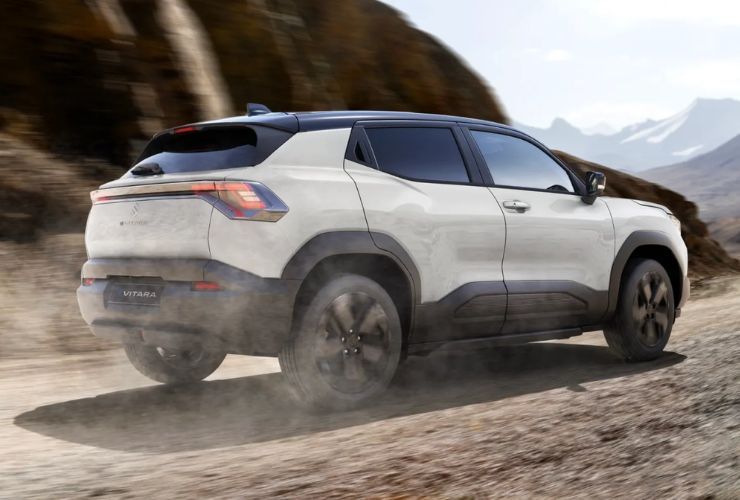
Maruti has not gone soft on the product itself. The eVitara comes with two battery pack options, 49 kWh and 61 kWh, and a claimed range of up to 543 km. Prices run from Rs 15.99 lakh to Rs 19.79 lakh, while the battery subscription route drops the starting vehicle price to Rs 10.99 lakh, with a per-km battery fee. There is also an 8-year or 1.6 lakh km battery warranty, plus a standard 3-year vehicle warranty.
That gives Maruti a few clear talking points. The entry price looks more approachable under the battery subscription model. The claimed range is competitive on paper.
The warranty package is strong enough to address some first-time EV hesitation. And Maruti has also tied the launch to early-ownership benefits like complimentary charging support and a home charger package.
So this is not a case of an underprepared product entering the market. The car has enough on paper to be taken seriously.
The bigger takeaway is that February was more of a positioning month than a verdict month. Maruti has shown that it can move stock into dealerships quickly. It has also shown that the eVitara will not instantly become a high-volume EV just because of the badge.
For now, the most honest reading is this: the eVitara has made a clean start, but not yet a breakout one. The dispatch number shows intent. The retail number shows distance still to cover. And when the same month’s leaders are already doing between roughly 1,000 and 3,500 units, the scale of the climb becomes obvious.
March and April will matter more than February. If retail numbers rise sharply from here, the February gap will look like a normal launch-phase lag. If they do not, then the market will start asking harder questions about whether Maruti’s first EV is attracting curiosity, or genuine buying momentum.