Mercedes-Benz Records Best Ever Sales in India: Retains Leadership In Luxury Car Segment


Mercedes-Benz India closed FY26 with 19,363 retail sales, its highest annual volume in the brand's history here. The previous best was 18,928 units in FY25. The 2.3 percent year-on-year increase looks modest in percentage terms, but it came in a year when the brand's entry luxury segment, its most volume-sensitive category, dropped 18 percent.
That the company still posted a record is a direct result of its top-end portfolio doing the heavy lifting. In absolute terms, the company added 435 more units than FY25. That works out to an average of about 1,614 cars a month in FY26, up from roughly 1,577 a month in FY25. On a quarterly basis, Mercedes averaged around 4,841 units in FY26.
Q1 2026 added 5,131 units, up 7 percent from 4,775 in Q1 2025, suggesting the momentum from FY26 has carried into the new fiscal year. The year-on-year gain in Q1 alone was 356 units. If that quarterly pace were to hold through the rest of the year, Mercedes-Benz would be running at an annualised rate of more than 20,500 units, which gives a clearer sense of how close the brand now is to the 20,000-unit mark on a steady basis.

The top-end segment, which covers Mercedes-Benz vehicles priced upward of Rs 1 crore including the S-Class, AMG lineup, Mercedes-Maybach range, and EQS SUV, grew 16 percent in FY26 and contributed 27 percent of total sales. In Q1 2026, that segment grew 25 percent. These are not the models that sell in the thousands, but they are the ones that carry the brand's margin and image.
Put into volume terms, a 27 percent share of 19,363 units means the top-end portfolio contributed about 5,228 cars in FY26. Based on the stated 16 percent growth, that also implies the same segment was at roughly 4,507 units in FY25. In other words, top-end luxury added about 720 units year on year, which is more than the brand's total net gain of 435 units. That tells its own story: without growth at the very top, Mercedes-Benz India would likely have ended the year below its previous record because the rest of the portfolio collectively lost volume.
Waiting periods tell the demand story plainly. The AMG G 63 currently has a 12-month wait. The Mercedes-Maybach S-Class is at a similar 12-month queue in some markets. Products like these do not go on discount; they are delivered on allocation. The fact that they are both oversubscribed is the most direct indicator of where the demand is genuinely strong.
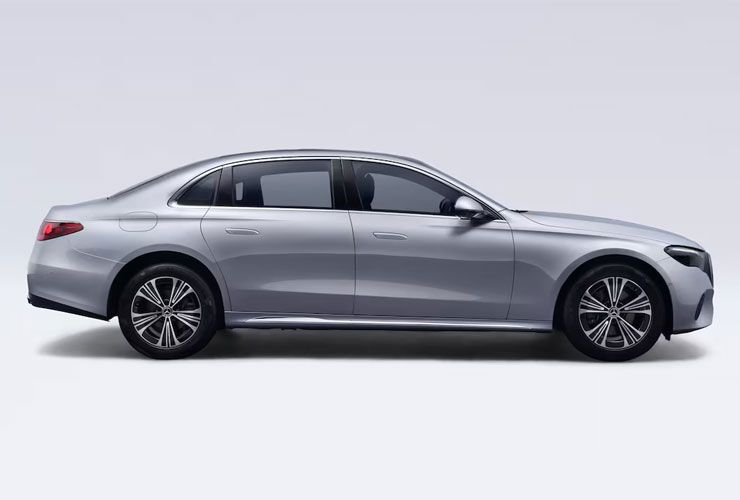
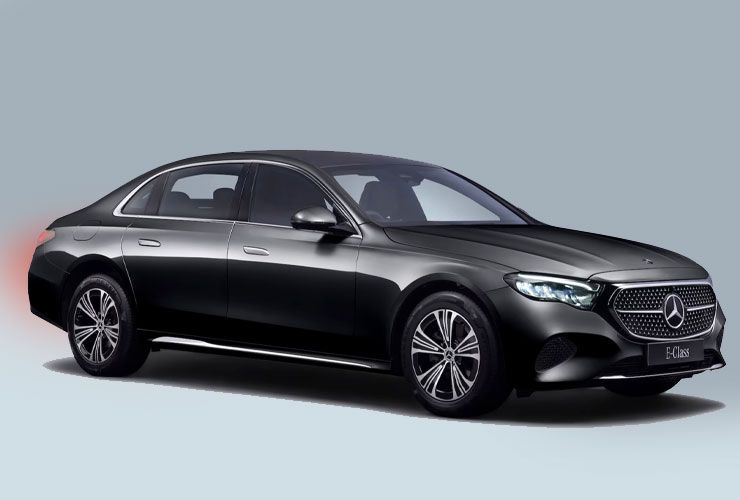
The Long Wheelbase E-Class remained the highest-selling luxury car in India through FY26, retaining a position it has held for several consecutive years. The E-Class LWB's appeal is in its combination of rear-seat space, the E 450 performance variant, and its relatively accessible pricing versus the S-Class. It sells to both private buyers and chauffeur-driven buyers, and nothing from BMW, Audi, or Volvo has managed to dislodge it from the top of the luxury sedan chart.
That is important because the wider luxury market has increasingly tilted toward SUVs over the past few years, yet Mercedes-Benz continues to have its single biggest product success in a sedan body style. It also shows how much value there still is in the chauffeur-use case at the upper end of the market. The E-Class LWB is not just a strong model line for Mercedes; it is one of the clearest examples of a manufacturer tailoring a global product to local luxury buying habits and getting the formula right repeatedly.

Battery electric vehicles now account for 20 percent of all top-end Mercedes-Benz retail volume in FY26. Top-end BEVs priced above Rs 1.4 crore grew 85 percent. The EQS SUV was the highest-selling BEV in the Mercedes-Benz lineup. The EQS Maybach SUV and the electric G-Class also contributed to this tally.
Here too, the math adds perspective. If top-end models contributed around 5,228 units, then BEVs at 20 percent of that pie amount to roughly 1,046 vehicles. With growth of 85 percent, the comparable number a year earlier would have been in the region of 565 units. That means Mercedes-Benz added roughly 480 high-end electric vehicles in a single year. In a segment where volumes are inherently small and price points are extremely high, that is a substantial jump. It also suggests that for Mercedes-Benz India, the early EV story is currently being written from the top down rather than through entry luxury electrics.

On April 24, 2026, Mercedes-Benz will launch the CLA BEV, the first of what the company calls its next generation of software-defined electric vehicles. The CLA BEV sits considerably below Rs 1.4 crore and is expected to bring EV volume from a different buyer group entirely, those who want a premium electric car but do not want to stretch to the EQS price band.
At the same announcement, Mercedes-Benz introduced two new performance variants. The AMG A45 S Aero Track Edition 4MATIC is priced at Rs 87 lakh ex-showroom, with an optional Manufaktur Mountain Grey Magno paint at Rs 3 lakh extra. It uses a 2.0-litre four-cylinder producing 421 bhp and 500 Nm, with a 0-100 kmph time of 3.9 seconds. The Aero Track Edition adds a fixed rear wing, enlarged front splitter, and aerodynamically optimised rear diffuser, all in high-gloss black, calibrated for high-speed downforce and stability.

The AMG GLE 53 Coupe Performance Edition is priced at Rs 1.52 crore ex-showroom. It carries a 3.0-litre six-cylinder producing 435 bhp and 520 Nm, with a 0-100 time of 5.3 seconds. The Performance Edition adds the AMG Dynamic Plus package, active roll stabilisation, high-performance composite brakes with red callipers, AMG Performance steering wheel, and AMG Track Pace telemetry system. Wheels are 22-inch AMG cross-spokes in matt black.
On the network side, Mercedes-Benz is planning 20 new retail outlets in 2026, backed by Rs 450 crore in franchise partner investment. New facilities in Visakhapatnam, Varanasi, Goa, and Pune are planned for Q2 2026, marking the brand's formal debut in several emerging luxury markets. Spread across 20 outlets, that investment translates to an average of about Rs 22.5 crore per new facility. That is a significant network spend for a luxury brand at a time when expansion is moving beyond the biggest metro markets. It also shows Mercedes-Benz is not treating demand in cities such as Varanasi, Goa and Visakhapatnam as experimental. It is putting dealership-scale capital behind the assumption that the luxury customer base is broadening geographically, not just deepening in Delhi, Mumbai and Bengaluru.