3 New Car Brands Launching Soon In India


India is one of the fastest-growing markets for car manufacturers. That is the reason why we see so many new cars being launched in the market every year. India, as a market, is not that easy for brands, and there are multiple factors that influence customers here. Brands cannot implement a strategy that they have used in other markets. The customers and their needs are completely different here, which means every brand needs to have a tailor-made strategy for India. It is because of this that we see some brands doing well while others struggle. Along with the existing brands, we also see the entry of several new players in our market. Here is a list of three such new brands that are planning to enter India.
Earlier this year, JSW announced its plans to enter the Indian market as an independent car manufacturer. As part of their plan, JSW tied up with Chinese car manufacturer Chery and decided to bring some of their models under the JSW badge in India.
This is probably going to be the first model that JSW might launch in the country. Testing for this SUV is currently going on in several parts of India. This is a boxy-looking premium SUV that is already on sale in many international markets.

It gets a design inspired by SUVs like the Land Rover Defender. The Jetour T2 will be launched as a plug-in hybrid SUV. It will be powered by a 1.5-litre turbo-petrol engine. As this is a plug-in hybrid vehicle, the SUV will also have an electric motor and a large battery pack that is likely to offer an electric driving range of around 100 km. The SUV will be sold as a CKD, and JSW is also setting up a facility in Maharashtra.
After the Jetour T2, JSW will bring in a pure electric SUV, which is currently known as the iCar V23 in many markets. It is a rugged-looking SUV with design elements inspired by the likes of the Defender, Jeep Wrangler, and many other SUVs.

As mentioned above, this will be a pure EV, and internationally it is not positioned as a premium product. It comes with a decent number of features like a 15.4-inch touchscreen infotainment system, automatic climate control, leatherette upholstery, and a minimalistic cabin design with exposed plastic panels in some areas.
It is available with two battery pack options. The smaller 59.93 kWh battery comes with a rear-wheel-drive setup and offers around 401 km of range. Meanwhile, the larger 81.76 kWh battery comes paired with an all-wheel-drive system and offers up to 510 km of range.
The third SUV that JSW will launch in the market is a premium mid-size EV, the Jaecoo J5. Like the other two models, it takes inspiration from Range Rover models and comes with a clean and premium-looking exterior design.

As this is a premium EV, it comes with features like a vertically oriented touchscreen, a digital instrument cluster, a 540-degree camera system, ventilated seats, electrically adjustable seats with memory function, a panoramic sunroof, Level 2 ADAS, multi-zone climate control, and more. It will be powered by a 58.9 to 60.9 kWh battery and offer a claimed range of around 400 to 460 km. This EV will generate around 211 bhp and 288 Nm of torque.
The Stellantis Group has a presence in India in the form of Jeep and Citroën. We all know that both brands are not doing great in our market, and as part of its expansion strategy, Stellantis now plans to introduce electric vehicles in India. To achieve this, they have tied up with Chinese EV brand Leapmotor. Leapmotor was founded in 2015 in Hangzhou, China. In the new joint venture, 51 percent of the stake is owned by Stellantis. The initial models are likely to be introduced as CKDs, and local manufacturing will depend on market demand.

One of the models that Leapmotor will bring to India is the T03 compact electric hatchback. This will compete with the likes of the Tata Tiago.ev and MG Comet EV. This compact EV comes with features like a touchscreen infotainment system, an electric sunroof, a minimalist dashboard design, Level 2 ADAS, air conditioning, and more.
It is expected to come with a 37.3 kWh battery pack offering a range of around 265 km, which is suitable for city usage.

This mid-size EV will rival models like the Creta EV, VinFast VF6, and MG Windsor EV in the segment. Like most Chinese brands, the Leapmotor C10’s design appears inspired by other international models. It will be offered with a decent number of features and is expected to be powered by a 69.9 kWh battery pack offering a range of around 420 km.
The third EV that Leapmotor will bring to India is the B10 SUV. This SUV is already available internationally and comes with premium features like LED headlamps, DRLs, tail lamps, and flush-fit door handles, which are commonly seen in modern EVs.

It is expected to be offered with two battery pack options: 56.1 kWh and 67 kWh, with the larger battery pack offering a range of around 434 km.
Hyundai has been evaluating the Indian market for over a year to introduce its luxury brand Genesis in India. At an investor day presentation, they confirmed the same, and the brand’s entry is expected to happen in 2027. Genesis is expected to focus on SUVs and will likely sell its models as CKDs in India.
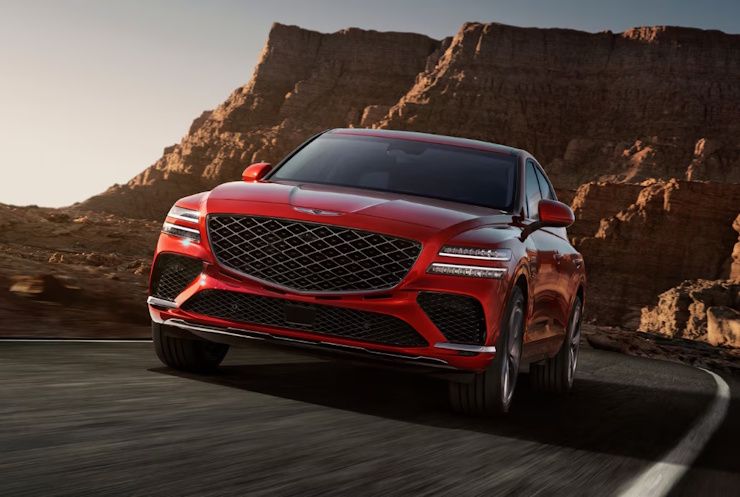
Genesis is expected to bring the GV80 SUV and coupe SUV to India first. Hyundai has already trademarked the GV80 Coupe in India. The model is available in both standard SUV and coupe SUV formats.
The GV80 features Genesis’ signature crest-shaped grille along with a twin horizontal headlamp setup on either side. At the rear, the SUV gets the same twin-lighting setup. The coupe gets a sloping roofline, while the standard SUV variant has a more traditional boxy design.
The Genesis GV80 is available with three engine options internationally: a 2.5-litre turbo-petrol engine producing 304 PS, a 3.5-litre turbo-petrol engine generating 380 PS, and a 3.5-litre engine paired with a 48V electric supercharger producing 415 PS and 549 Nm. It remains to be seen which engine options will be offered in India.