Tata Nexon.EV or Curvv.EV With The Mega Price Drop: What To Pick


When it comes to electric cars, the Tata Nexon.ev is one of the best-selling EVs in the Indian automotive market. In fact, it was the best-selling EV in India for a very long time. Now, if you are in the market to buy an EV and are looking to buy the Nexon.ev, you should also consider checking out its sibling, the Curvv.ev. Today, we will help you with all the facts about these two siblings so that you know which one you should pick.

First off, let's talk about the Tata Curvv.ev, which is the elder sibling of the Nexon.ev. With the Curvv.ev, what you will be getting is a much more premium-looking vehicle which boasts a sloping roofline. This type of rear-end design is mostly seen on more expensive luxury cars. Apart from the design, the Curvv.ev also has a lot more to offer in terms of power and performance.
The Curvv.ev comes offered with a more powerful electric motor than the Nexon.ev, and it is capable of producing 167 bhp and 215 Nm of torque. It can perform the sprint of 0 to 100 kmph in just 8.6 seconds. This faster acceleration will help you on highways during overtaking.

Apart from the power figures, another added advantage of the Nexon.ev is that it comes offered with a bigger 55 kWh battery pack option. It offers a claimed range of 55 kWh, which in the real world provides a range of 370 to 420 km. The longer range means there will be less range anxiety.
One of the most obvious benefits of buying the Curvv.ev is bigger boot space. It offers 500-litre boot space along with an 11.6-litre frunk, which makes it more practical. Lastly, it also offers 80 kW DC fast charging support, which means it takes only 40 minutes to charge from 10 to 80 percent. Once again, it is a very useful upgrade over the Nexon.ev.

Pricing of the Curvv.ev is also what makes it now more lucrative. Recently, Tata Motors launched the Curvv.ev Series X at Rs 16.99 lakh, which goes up to Rs 19.99 lakh (basically, this is the discounted price, as before the Curvv.ev was getting a discount of Rs 3.3 to Rs 3.8 lakh). Earlier, the pricing of the Curvv.ev reached Rs 22.24 lakh for the top-spec variant. However, with this pricing, it makes a lot of sense, as the top-of-the-line Nexon.ev is only slightly more affordable at Rs 17.49 lakh.

Like everything, the Curvv.ev also has its downsides. The first is that even though the power figure is bigger than the Nexon.ev, its torque remains the same at 215 Nm. Also, the coupe design and the sloping roofline may not be liked by everyone. This also reduces the headroom a bit, so taller people in the rear might become uncomfortable. Also, as the battery pack is bigger, it will consume more electricity while charging, which for some may be a negative.
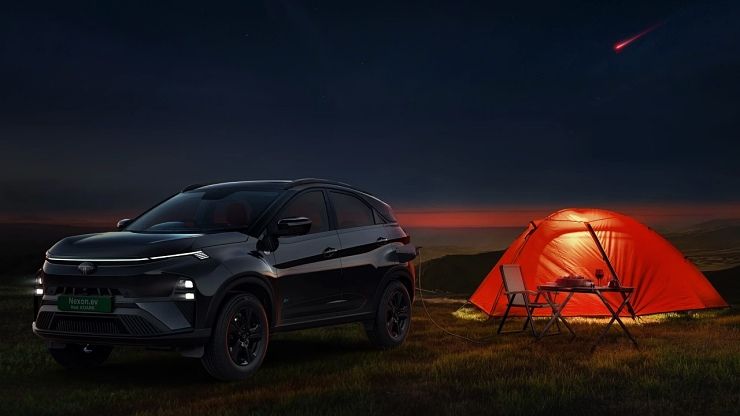
Now, coming to the Nexon.ev and who should buy it. If you are someone who cannot stretch their budget over Rs 20 lakh for the top-of-the-line variant, then the Nexon.ev will be perfect for you. The top-of-the-line variant is priced at Rs 17.49 lakh, which will be around Rs 2 to 3 lakh cheaper when compared to the Curvv.ev (on-road).
As for the powertrain, it has to be mentioned that even though the Nexon.ev is slightly less powerful at 142 bhp (compared to 167 bhp of Curvv.ev), it is still plenty quick. Also, it offers the same 215 Nm of torque as the Curvv.ev. Another reason to buy the Nexon.ev is its size. Not everyone wants a bigger vehicle due to the problems of maneuverability in the city. So, if you are also someone who is looking for a compact electric vehicle, then the Nexon.ev will suit you better.

Now, coming to the downsides of the Nexon.ev, it boasts a much smaller 350-litre boot, which may seem small to some buyers. Additionally, the main drawback, when compared to the top-of-the-line Curvv.ev, is the smaller 45 kWh battery pack. This battery pack offers a claimed range of 489 km, which in the real world is around 330 to 370 km, which is lower than the 380 to 400 km of the Curvv.ev. Lastly, the Nexon.ev also offers 60 kW DC fast charging, which in the Curvv.ev is 70 kW.